The information found in the captions is derived from the exhibit except those found in parentheses. Those are my own words.
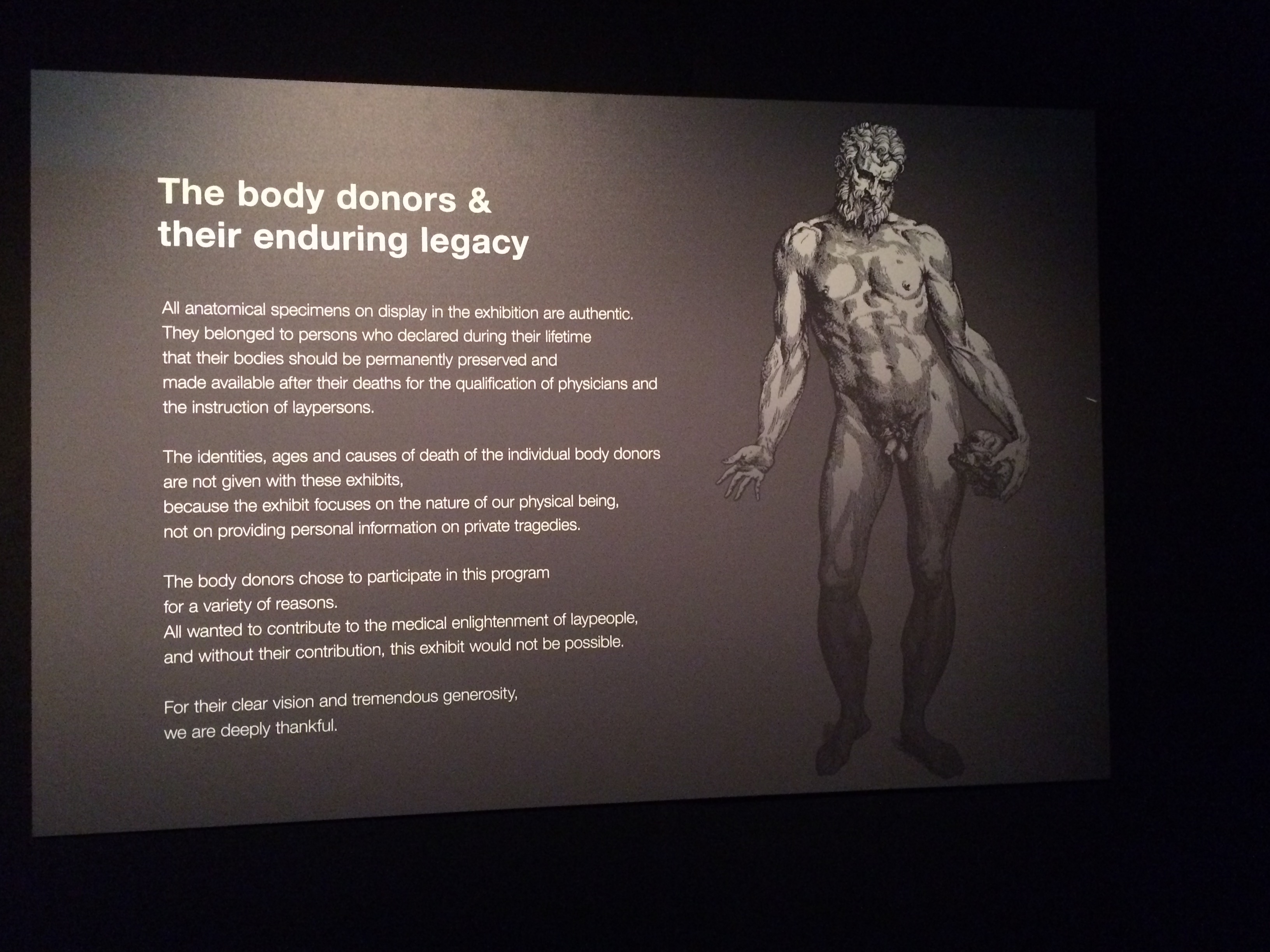
As the above picture comments, these were once living people who gave permission to use them for scientific and educational purposes. I hope you enjoy the pictures as much as I enjoyed viewing the exhibit, keeping in mind to respect the bodies and parts involved.
Shall We Continue with Blood?
And Explore The Specifics?
Heart
The heart is a hollow, muscular organ constantly pumping blood around the body. It’s muscle fibers run spirally so that it can squeeze blood into the arteries. The size of the heart is roughly that of our fist and weighs approximately 10 ounces. It pumps about 3 ounces of blood with each beat. At rest, the heart rate is about 70 beats per minute. This adds up to roughly 1 million barrels of blood over a lifetime of about 75 years. That is enough to fill more than three supertankers.
Coronary Arteries
The cardiac muscle has its own blood vessels to supply it with oxygen and nutrients. They are called coronary arteries. Two main arteries branch from the aorta and subdivide into smaller blood vessels that penetrate the heart muscle. At rest, the heart needs more oxygen than almost any other organ does.
Foot Arteries
Blood consists of a pale liquid called plasma in which billions of red and white blood cells and platelets are suspended. Red blood cells transport oxygen and carry away carbon dioxide. A red blood cell travels a total of about 12,000 miles a day and may circumnavigate the entire body in less than 20 seconds. The colorless white cells are part of the body’s built-in defense mechanisms. Platelets are involved in blood clotting.
Big Heart
All muscles increase with exercise including our heart muscles. A normal heart weighs around 11 ounces, but an athlete’s heart can weigh over 18 ounces. However, the heart also enlarges under strain, such as that caused by high blood pressure, defects in the heart all, or faulty heart valves.
Aortic Arch
Arteries are elastic tubes that transport the oxygenated blood from the heart to all regions of the body. The aorta is the largest artery in the body. The interior wall of a young, healthy artery is completely smooth, as is the aorta shown here. To ensure the blood supply to our organs, our body monitors and regulates the blood pressure in the arteries. If arterial pressure is too low, not enough blood reaches the body tissue. If pressure is too high, it may damage blood vessels and organs.Blood vessel configurations are perfect samples of the inner profiles of blood vessels. The vessels are first injected with a dyed plastic. By the time the plastic has cured, it has taken the shape of the vessels. The surrounding soft tissue can be then removed mechanically and chemically with the aid of ferments. Here, only the main arterial branches are shown. If the capillaries were also injected, the arterial network would look so dense that no one could distinguish single blood vessels.
Blood Vessels in Head
The blood circulation in our skin affects its coloring. This is particularly true for the face, because in the face there are numerous tiny blood vessels beneath the skin. Heat, intense physical activity, or stress hormones may cause these vessels to widen, which makes us turn red in the face.
Leg Arteries
(I didn’t get a caption for the leg arteries. A little unbelievable, but realistic, nonetheless.)
Brain Arteries
The brain has an extraordinary high demand for blood. It is only 2% of our total body eight, but needs 20% of our blood supply. If the blood flow to the brain is interrupted for longer than 10 seconds, cells will not receive enough oxygen or nutrients and the brain can suffer severe tissue damage. This condition is called a stroke.
Intestinal Blood Supply
The small intestine absorbs almost all nutrients into the bloodstream. To accomplish this, the small intestine’s lining is equipped with an extraordinarily fine network of blood vessels. After a meal, the blood supply to the intestines increases considerably. The absorbed nutrients flow to the liver via the portal vein for further processing
Arteries of the Body
Generally speaking, the vessels represent major highways that distribute blood to the body. They taper down more and more as they pass into the organs and tissues to form and intricate network of minute, hair-like vessels called capillaries. It is here that the interchange of nutrients, oxygen, and other substances takes place between the blood and tissue cells. The network of arteries, veins, and capillaries is extraordinarily dense. In an adult, this network is more than 60,000 miles long. Laid end to end, it would wrap around the earth more than twice. Here, only the main arterial branches are shown. This amazing system of tiny tubes is vital for our survival, and keeping it healthy is an important ingredient for living a long and vigorous life.
This concludes the blood. I originally had one more post. There are now two. The next post involve organs and remaining body parts. The last post will be information that may or may not be interesting and helpful.






 Pisaries Creator