Porcelain Bowl (15th century) by Prix (Own work) [CC BY-SA 3.0 (https://creativecommons.org/licenses/by-sa/3.0)%5D, via Wikimedia CommonsI took a few ceramic courses, and let me tell you, ceramists have some of the most sculpted and muscular arms when you’re talking about artists. I was strongest when I threw clay. Weights would do the same thing, but for it to be a natural thing without thinking about it, wheel work does the job. Centering clay and raising it up defines your muscles like nothing else. You definitely need to know your craft to be a good thrower and hand builder. I hope to get back into it at some point. Without further delay, it’s time to discuss the greatness of Korean ceramists.
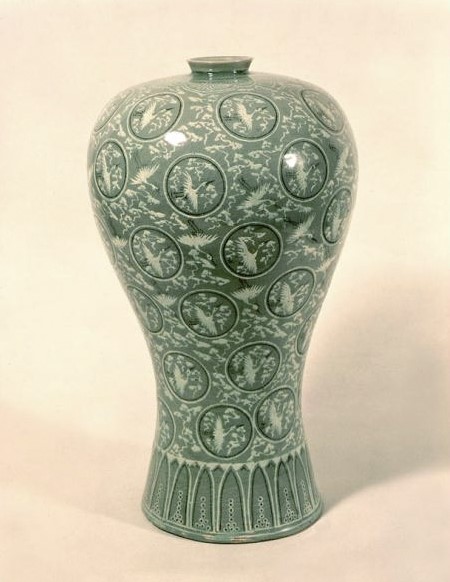
Vase with red cranes (12th century) by the original uploader was Korea history at English Wikipedia (Transferred from en.wikipedia to Commons.) [GFDL (http://www.gnu.org/copyleft/fdl.html) or CC-BY-SA-3.0 (http://creativecommons.org/licenses/by-sa/3.0/)%5D, via Wikimedia CommonsChina permeated much of Asian art forms and ceramics is no exception, but over time Korean ceramists created works with a style all their own. The moon jar is one example and celadon (green glaze) was often used. Korean mainly used earthenware and porcelain. I’ll let you know right now porcelain is extremely difficult to work with, but when you are good at throwing it, you’ll get some amazing pieces. I wasn’t one of them, but I watched one student with glee that definitely excelled at creating beautiful pots.
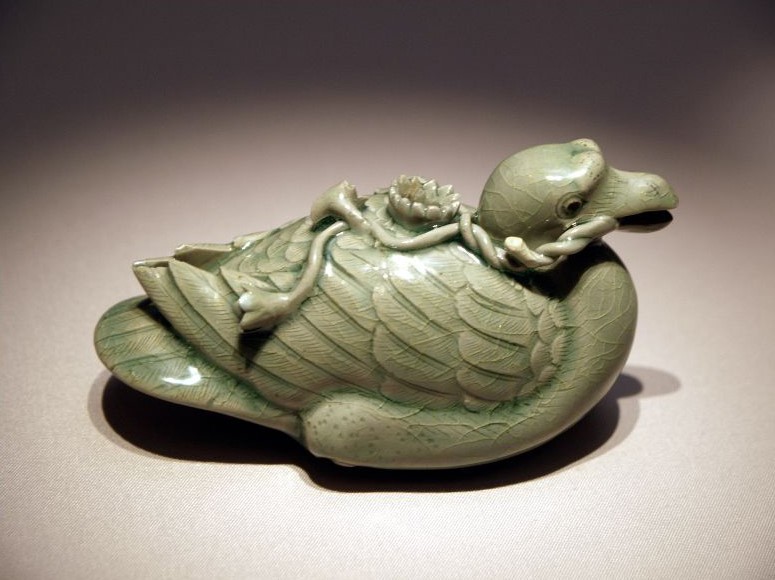
Celadon incense burner from Goryeo Dynasty (918-1392) by Steve46814 (Own work) [CC BY-SA 3.0 (https://creativecommons.org/licenses/by-sa/3.0)%5D, via Wikimedia CommonsThe primary religion in Korea is Buddhism with its principles deeply rooted in its culture. This provided a need for celadon wares with animal and bird motifs. Around this time, iron powder was also added, which made the glaze shinier and more durable. The inlay technique started during the early 12th century. This meant that designs were incised into the clay: foliate designs, geometric or scrolling bands, elliptical panels, stylized fish, insects, and birds. The inlays were often in white and black.
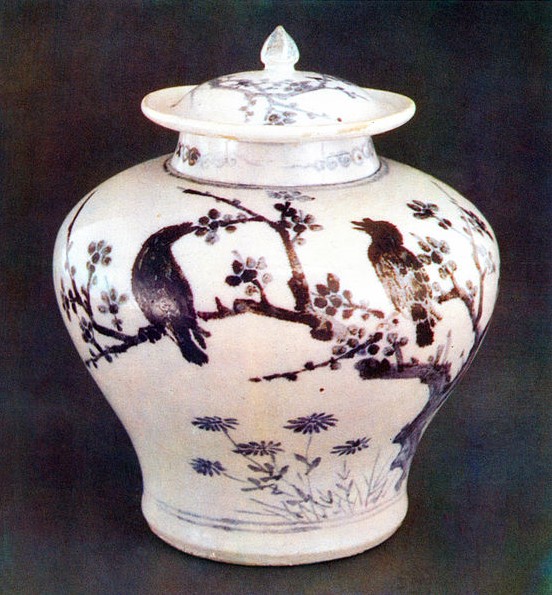
Blue and white porcelain jar from Joseon Dynasty (15th century) by Korea Copyright Commission, via Wikimedia Commons
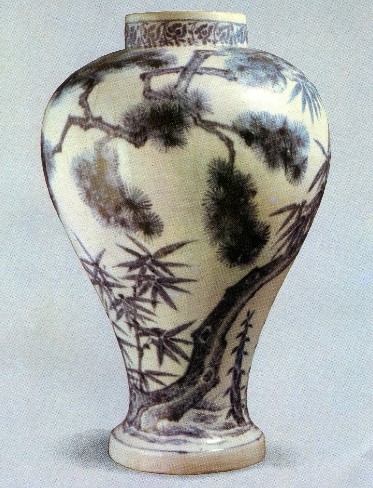
As with any country that is ruled by kings and queens, white wares became synonymous with nobility and royalty. This high quality of work still survives from the Joseon dynasty from 1392 to 1897. Ceramics arising out of this period is primarily divided into three periods: 1300 to 1500 early period, 1500 to 1700 middle, and 1700 to 1900–1910 late period.
Blue and white porcelain jar with pine and bamboo designs from Joseon Dynasty (1489) by Korea Copyright Commission, via Wikimedia Commons
This served as a turning point as Korea was annexed by Japan in 1910. When Japan surrendered during World War II, the 1905 and 1910 treaties between the two countries were no longer in effect. The Korean ceramists’ influence of that period remain today, and continues to be as relevant as it did back then.




 Pisaries Creator
Leave a comment