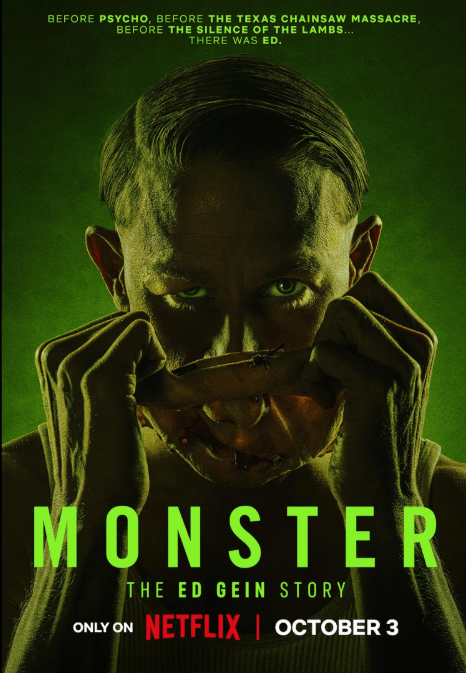
I’ve watched the Monster series covering Jeffrey Dahmer and the Menendez brothers and while their stories had their own kind of horrific moments, this one covering Ed Gein takes on a different feel because it was more graphic than the others. I would say this is one of the better performances I’ve seen from Charlie Hunnam despite critics saying otherwise. I saw less Charlie Hunnam than in his other roles although I have to applaud Laurie Metcalf playing his equally disturbed mother, Augusta Gein, and Vicky Krieps playing Ilse Koch, a Nazi war criminal. Those were the two actresses that stood out the most regarding their roles.
The viewer will appreciate how the series connected serial killers with the making of Psycho, Texas Chainsaw Massacre, and Silence of the Lambs from a horror movie standpoint. The more discerning viewer will be disappointed with how the series seemed to only hit the surface when it came to Ed Gein as a person. He was a disturbed person but to chalk it up to his super religious mother doesn’t explain it all. There are graphic scenes that may be construed as mere shock factor. The viewer still got some insight into Ed Gein’s mindset. He was a seriously flawed man but so was Alfred Hitchcock in a different way. The creators Ryan Murphy and Ian Brennan took creative liberties in these eight episodes.
In the first episode, Ed Gein lives on a farm in Plainfield, Wisconsin, with his mother Augusta. His conflicted relationship with his mother continues long after he achieves physical freedom from her. He is able to find companionship with his girlfriend, Adeline that introduces him to Ilse Koch through photos. In the second episode, Ed Gein finds a deeper connection with Ilse Koch and reveres what she does. Alfred Hitchcock is in the early stages of Psycho. He casts Anthony Perkins as Norman Bates. In the third episode, Ed Gein is suspected of having something to do with Mary Hogan’s disappearance. He is shown photos of Christine Jorgensen by Adeline. They agree to marry when he proves he can be normal around children. In the fourth episode, Ed Gein is being reminded by his mother that she doesn’t approve of what he is doing with women. His reaction to her demands leads him to chase after two hunters with a chainsaw. This references to Tobe Hooper’s The Texas Chainsaw Massacre.
The fifth episode finds Ed and Adeline separating. She briefly moves to New York City but returns when she finds herself starving and living without heat. Her relationship with Ed remain strained and she tries to please her mother on her return but with negative results. The sixth episode deals with Ed being arrested and denies what he is being charged. Adeline is ridiculed for pretending to be a reporter. The seventh episode is when Frank is dealing with the death of his mother through drinking while Ed is hallucinating having conversations with Ilse Koch over the radio. A nurse watching over him forces him to take medication for his schizophrenia. The eighth episode focuses on the last years of Ed where serial killers are still out there with Ted Bundy, Richard Speck, and Jerry Brudos. Changes have taken place within the FBI with criminal profilers. He is still in touch with Adeline. Ed finally dies from lung cancer where he is greeted by his mother.
Most of the remaining cast includes Hudson Oz as Henry Gein, Darin Cooper as George Philip Gein, Suzanna Son as Adeline Watkins, Tom Hollander as Alfred Hitchcock, Olivia Williams as Alma Reville, Robin Weigert as Enid Watkins, Charlie Hall as Deputy Frank Worden, Alanna Darby as Christine Jorgensen, Joey Pollari as Anthony Perkins, Rondi Reed as Mary Hogan, Tyler Jacob Moore as Sheriff Schley, Sean Carrigan as Robert Ressler, Caleb Ruminer as John E. Douglas, Mimi Kennedy as Mildred Newman, Ethan Sandler as Robert Bloch, Jackie Kay as Tab Hunter, Will Brill as Tobe Hooper, Lesley Manville as Bernice Worden, Golden Garnick as Ted Levine, Brock Powell as Gunnar Hansen, Tobias Jelinek as Richard Speck, John T. O’Brien as Ted Bunny, and Happy Anderson as Jerry Brudos.
While this is based on true crime but there are many scenes that don’t go in depth into the actual horrors committed by Ed Gein. There might be little empathy for the dysfunctional family he was born and raised by the viewer, but it should go no further. The way Gein was portrayed could have made the viewer empathize with him more than a little bit which would be wrong. The victims and survivors should always be put ahead of the person offending. Historical accuracy and factual evidence are important when it comes to any news or entertainment medium. Sometimes it’s good to remember a movie or TV show is only entertainment with sensationalism and biases. Therefore, I enjoyed watching this series because it didn’t claim to be a documentary or a TV show with gravitas.
I rate Monster: The Ed Gein Story THREE FINGERS at 80%.



 Pisaries Creator
Leave a comment